Tuesday, March 25, 2014

Calving in Pictures--Days 7, 10 & 11

Day 7
Unfortunately, cows don't calve every day, or on schedule.  We went almost a week without having a calf, and then on the first day of spring, during a blizzard, 312 decided it was her turn to calve.  I keep a good watch on the cows especially during inclement weather.  On Thurday, I was vigilant on checking the cows every 2 hours.  Wet and windy weather is the worst for newborn calves.  I went out at 2:30 in the afternoon and found 312 looking like she was going to calve really soon.  She ran into the catch pen, and I locked her in there so I could keep a closer eye on her.  She was very nervous, so I left her so she could calm down and have her calf.  I came out an hour later to check her and still no calf, but she was exhibiting signs that she had calved already, strange.  I left her, though, as she was very nervous and wasn't appreciating my presence.  I came back an hour later, and still no calf, so we ran her into the head catch where it's safe and easy to physically check if she has a calf in her that may be malpresented.  Both my husband & I palpated her to see if there was a calf inside and nothing.  We turned her back out, and later that evening we found her calf.  It was where she was all day in the catch pen, but it was dead.  We are still unsure what went wrong, but the signs she exhibited when I found her and when we palpated her all point to another stillborn calf.
Calf snuggled up in the windbreaks and straw during the blizzard
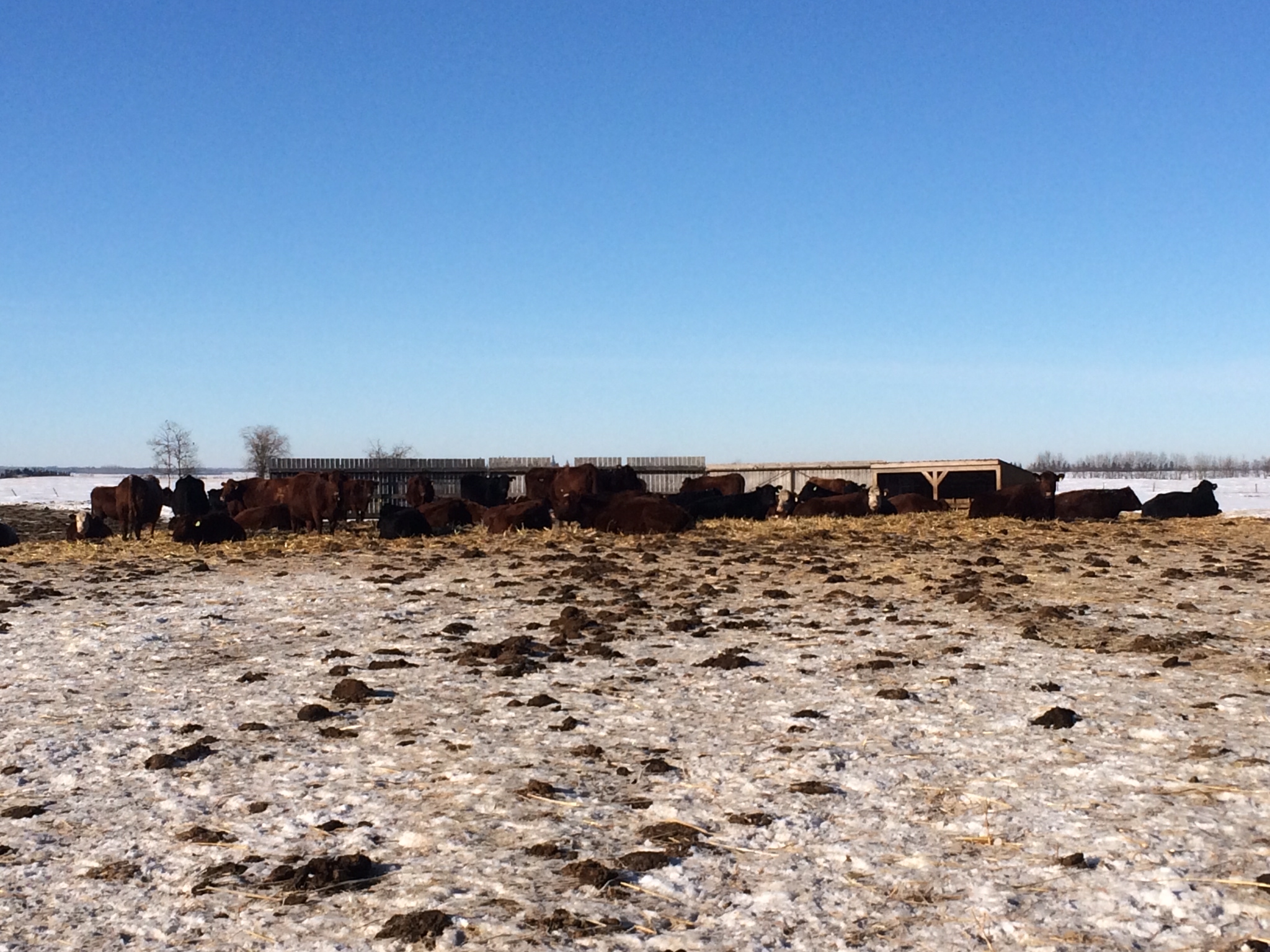
Cows gathered on the bed pack behind the windbreaks during the blizzard
Day 10
I came home from my weekend in Calgary for the Cattlemen's Young Leaders semi-finals, and went out to the cows immediately.  While I was gone, my husband and the kids kept a close eye on the cows, but no one decided to calve.  I drove around and a few exhibited signs of calving: swollen vulva, mucus, and engorged udders, but no calves.  I went out a few hours later and V31 had calved a nice big red bull (boy that has not been neutered) calf.  I was happy as he was up and nursing his mom.
V31 licking her calf and bonding with him
Day 11
Again, my morning checks have been disappointing, as in no calves overnight.  I noticed that S1Q was looking like she was getting close, and I was right.  At my mid-morning check she had birthed a nice black heifer calf.  The calf was very spry, up nursing, and already trying to buck and run.  New calf coordination isn't the greatest, so she was pretty funny to watch!
S1Q baby came up to check me out

Sunday, March 16, 2014

Calving in Pictures Day 1 & 2

Day 1
Calving officially arrived on the afternoon of March 14 here at the farm.  Unfortunately, our first cow (R44) had a stillborn calf.  She was an older cow--9 years old, and the days leading up to her calving she had shown signs that there was something "not right" with the calf.  She did not form a large udder (a cows milk usually comes into the udder a few days prior to calving) until after she calved.  We did not throughly investigate the stillborn calf, as the cow was older, which could be a cause, and she would not let us near the calf.  This is normal for the cow to stay with her dead calf and "mourn" for a few days.

Cow mourning calf

Day 2
On Saturday we woke up and checked the cows and one heifer (female cow before she has had her first calf ) numbered Z02 had a nice healthy, alive heifer calf.  This really lifted my spirits.  I know there was not anything I could have done for R44 but my mind always thinks "what if I would of been out here earlier"  I usually check the cows every 2-3 hours during the day, so I took the kids out with me at 10:30 am to show them the new baby.  The kids always get excited during calving season and love seeing the new babies.  There wasn't anyone showing any signs of calving, so we went back in.

 Z02 Heifer with her calf
We carried on with our morning and had lunch.  After lunch I went back out because I wanted to make sure the new little one was up and mom was letting her nurse.  A calf has to have the mothers first milk called colostrum to give the calf antibodies to the environment around it as they receive no antibodies from the placenta.  When first born, the calf's stomach is porous, allowing proteins from the colostrum to be absorbed.  As time goes on after birth, the pores in the stomach wall slowly close up.  For maximum antibody protection the colostrum needs to be consumed within the first 6 hours of birth.  When I went back out, I found another heifer (Z21) that had just had her calf.  The calf was still wet, but her mom was licking her off.  After the calf is born, the cow licks it off, this not only stimulates and warms the new calf.  It also helps the mom bond with her baby, transfer her scent to it, and helps her recognize the features of the new calf that identify it as hers.  I left the new mom and baby alone to bond.  I continued to check every 2-3 hours on our two new pairs.  Everyone was doing well and we did our last check at 9:30 pm when we got home from supper at our local community hall.

Z21 waiting for her calf to catch up to her

Saturday, March 1, 2014

Agvocate or Educate? The Great Debate

Advocate: (v) to speak or write in favour of; support or urge by argument; recommend publicly
Educate: (v) give intellectual, moral, and social instruction to (someone, esp. a child), typically at a school or university.

If you follow any agriculture social media you might be familiar with the term "agvocate".  If you haven't heard of the term before, to "agvocate" is to be a advocate for agriculture.  There has been some debate lately whether we as farmers should "agvocate".  I did an interview recently while I was at FarmTech and one of the questions was how do I feel about agvocating.  I initially said that I do it, but it's not for everyone.  As time wore on, I began thinking, do I actually advocate for agriculture, or am I trying to educate people?

My main goal of my blog is to do the latter--provide information (educate) to people about what we do. More and more I'm having a hard time with the word "Agvocate", especially when I think of being an advocate as someone who urges by argument.  We as farmers shouldn't be urging people into information about agriculture by arguing with them.  However, I find on social media this is what seems to take place too often, whether it is intended or not.

We need to be quiet and listen to what the person is saying.  If they are asking questions, answer them.  If myths are being stated, provide the person with data that dispels the myth.  If we don't know the answer to their question, point them in the direction of someone who might.  We need to keep people from "Googling" answers because I feel that is how myths and misinformation gets spread.  These are just a few simple tips that we can use to help educate people about agriculture.

Not everyone is meant to be an agvocate, but we can all educate.

Sunday, February 16, 2014

The Felfie Bandwagon--Hop aboard y'all!

What started out as teenage girls taking selfies and posting them on Facebook has morphed into a whole new trend.  Enter the #felfie!  What is a "felfie" you might ask?  It's a farmer taking a selfie. What started as a photo contest with the Irish Farmers Journal for Ireland's greatest farmer selfie, then exploded around the world.
I think all farmers who engage in social media should join the felfie trend.  Why?  It's good for the industry. It shows consumers that farmers care for their food.  It is putting a face to the farm and making the connection to their food more personal.  If you're a farmer and reading this and would like to put your #felfie out there, email it to me and I will post it!
To read other's posts about felfies click here and here

The Furnace vs. the Freezer

Here in Alberta, we are known for our cold temperatures, and expect it to be cold during winter.  The winter of 2013-14 hasn’t been an easy one for temperatures.  From November until the middle of January we saw very cold temperatures and wind chills.  We’ve had a bit of a reprieve for about 15 days here, that has brought us temperatures that are above zero, but when you normally deal with -37C (-34.6F) for lows and your daytime high of -21C (-5.8 F), a few days above zero feels like a Tropical breeze (not really, but it does feel nice)!  When we look on the other side of the globe and hear of people dealing with temperatures above +40C (104F) our deep freeze doesn’t sound too bad!
While reading other farm and ranch blogs, I’ve made friends with Mandy, a fellow cattle farmer from north-west New South Wales, Australia.  Mandy writes an amazing blog called Rocky Springs Rambles, and this week, Mandy and I have gotten together to do a comparison of what each other has to deal with working outside in extreme temperatures.(Numbers in brackets are Fahrenheit for the folks that don’t do metric).
Official temperature: Australia: 42.5 (108.5); Canada -18.2 (-0.76), add the wind chill factor and you get -27 (-16).  Honestly Mandy, I think the only time in my life when I felt the weather THAT hot was went I was in Phoenix, Arizona in June!  I complain when the weather gets above 28 (82.4) here!

Temperature on the top of your hat
-15.3 (4.4)was the temperature at the top of my hat
In Australia: 49.2 (120)

Temperature underneath your hat

-13.8 (7) was the temperature underneath my hat
In Australia: 42 (107)
Water in the cattle troughs

14.5 (58) The troughs (seen here) are heated
In Australia: 33.8 (93)
Sitting with the cattle

Behind the cattle windbreaks: -18.1 (-0.5)
Under a shade tree in Australia: 40.6 (105)
Soil Temperature:
In Canada our soil is buried under 120 cm of snow!  So I’m calling it frozen.
In Australia: 37 (98)
Dog Pool in Australia: 30 (86)
No dog pool in Alberta in January!
Kitchen: Canada 20.8 (69) and that’s with the furnace running!
Australia: 38.1 (100)
Cold water tap in bathroom:
Canada: 16 (60)
Australia: 37.3 (99)

The thought of 40+ (104) degrees in January is nice, for a few minutes.  Sorry, Mandy, I don’t think I could live in the “furnace”.  Just too warm for me!  But I do hope your temperatures moderate a bit & that you all get some much needed rain!

Wednesday, January 29, 2014

On the move...

I recently added a blog to my website for anyone who has been following me on this blog, in hopes of drawing more of an audience to my website.  To read the new blog click here.  In the meantime I'll still post here until I get everything 100% moved over there.

Wednesday, January 15, 2014

Cows and The Cold--What we do to Help.

With the somewhat extreme weather that we have been experiencing this fall and winter, a lot of people ask how to the cows deal with this weather?  While it's easy to bring the farm dog in to sleep on the porch in the winter, for us it's difficult and would be quite cost prohibitive to build an indoor area large enough for the cattle to go.

First, I always remind people that cattle have been living outside for thousands of years and have natural defences that helps them survive in the winter.  All summer long the cattle graze on lush, green pastures; gaining weight and putting on a nice layer of fat to help keep them warm throughout the winter.  As the days and nights cool off in the fall, the cattle also begin to develop their winter coat.  Thick, dense hair protects them from the winter elements.
Cow with her winter coat
Cow with her slick summer coat for comparison

Once they are off summer pastures, they are kept on a winter pasture here on our yard.  We have an open front barn they can go in to get out of the wind, as well as several areas of wind breaks set up.  The wind breaks serve as shelter areas for the cattle to go behind and get out of the wind.  To encourage them to "hang out" there, we also place their straw bed-pack on the leeward side (the side where there is no wind).  When it is very cold out, the cattle will naturally huddle together and they stay warm by doing so.
The bed pack with windbreaks

During the cold, the cattle require more feed to eat and we meet their needs by feeding high quality hay to them.  Our hay is sent to a lab and the nutritional content is evaluated.  From this data we can select the right feed for their dietary requirements.  We also will feed the hay near their bed pack so they don't have far to travel and can conserve energy and focus on staying warm.
Tractor and bale grinder
Hay Yard

Cattle also require fresh water all the time.  The cattle have waters that are heated so they don't freeze.  In the winter this can cause some issues as pipes freeze, elements go out of watering devices, etc.  We are always checking the waters making sure that the animals have fresh water at all times.
Steaming waters mean they are working

The cattle are our lively hood, and during the winter we spend lots of time checking on the cattle and caring for them.  By making sure they are warm and happy when the weather is inclement keeps them heathy and ensures our cattle herd is around for years to come!
A happy cow = a happy cowgirl!